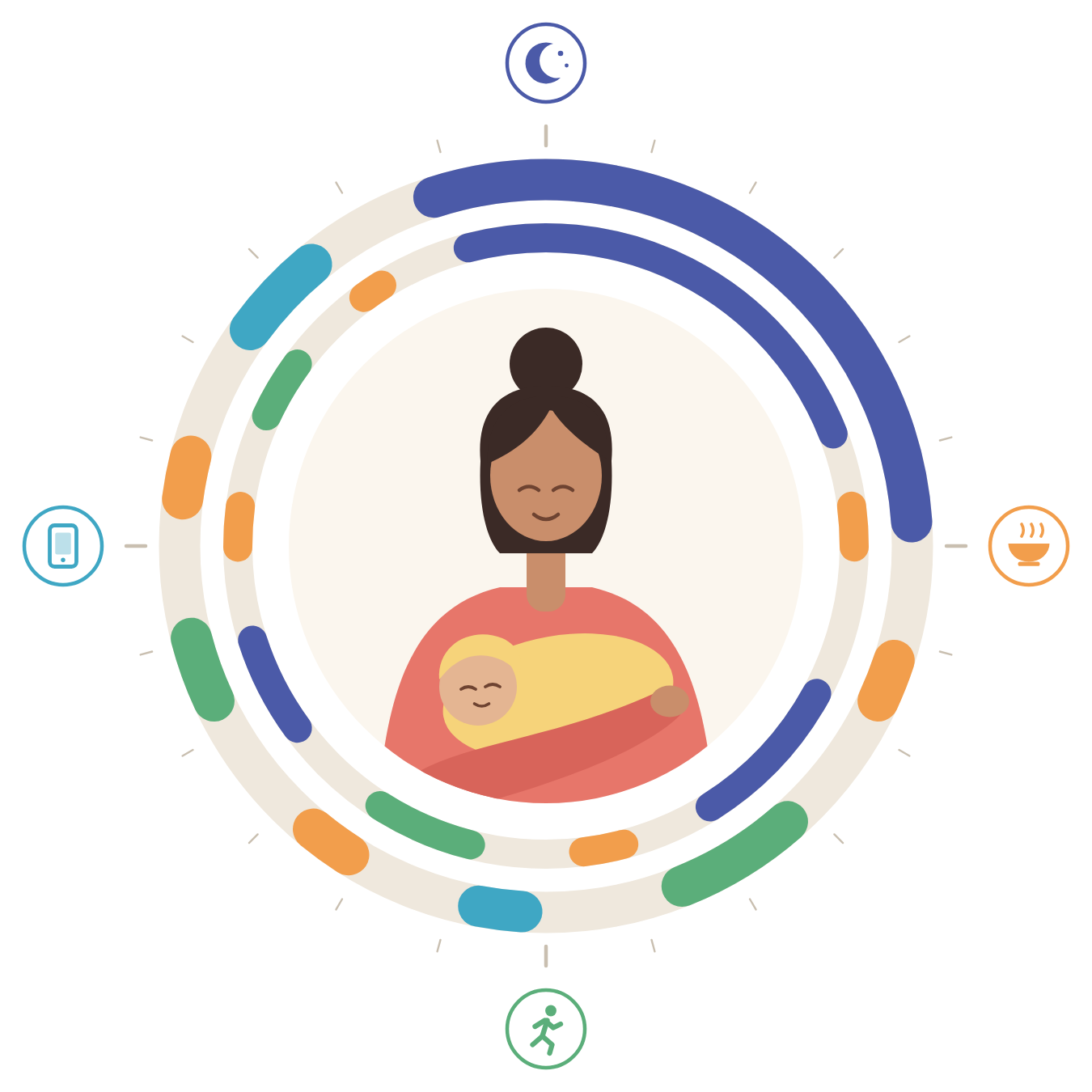
Timing Matters: Daily Routines of Moms and Young Kids
This study follows 500 mothers and their young kids through their child’s first two years. We're looking at how the timing and mix of daily activities, like sleeping, eating, moving, and screen time, shape the health of both mom and child, and how their routines influence each other over time. The goal is to design practical "time prescriptions" — simple guidance on when to sleep, eat, and move, that help moms and kids thrive.
Funder: NIDDK R01DK149684 (MPIs: S. Salvy, K. de la Haye)

Reducing Obesity Using Social Ties (ROBUST)
This pilot study tests a new approach to supporting weight loss among Black and Hispanic adults with obesity. We compare two versions of a healthy lifestyle program: one brings in the support of participants' family and friends, and the other is delivered to participants on their own. We are learning whether the social network-enhanced program works well for participants, and how it helps people overcome barriers to losing weight.
Funder: NIDDK 1R01DK135949 (PI: E. Phillips)
Smart & Connected Community Food Systems
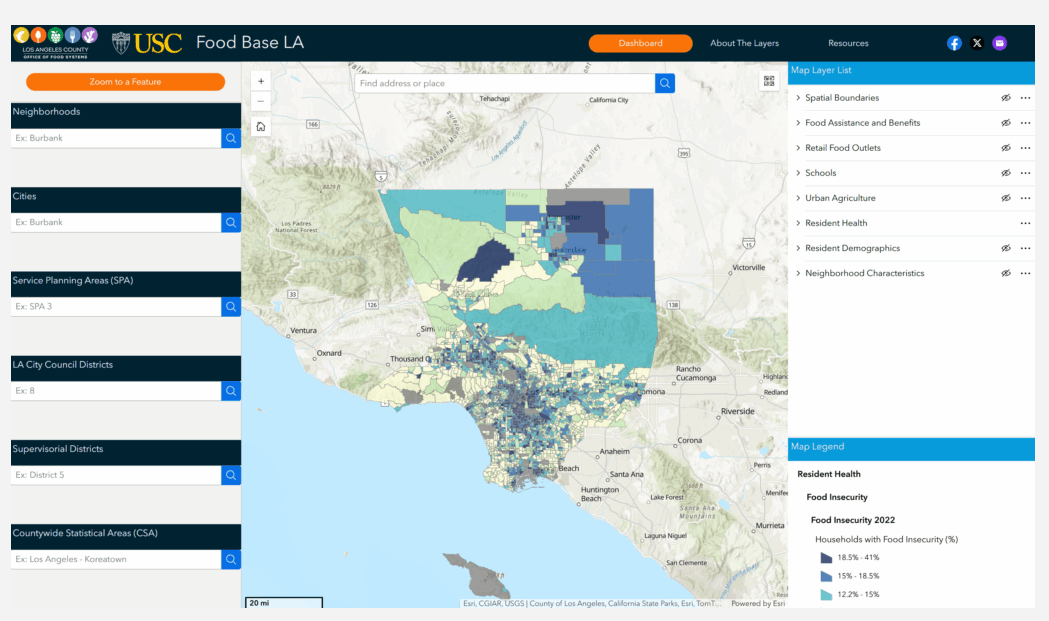
Food insecurity surged during the COVID-19 pandemic, but leaders lacked timely information about where the food system was failing. Working with scientists, county leaders, and community partners, we mapped the complexity of Los Angeles County's food system. We then assembled a broad data ecosystem, combining community perspectives with new data sources, to understand what affects residents' access to healthy food, especially during crises. We shared these insights through Food Base LA, a data dashboard now housed at the LA County Office of Food Systems. It offers a model other communities can adopt to build more resilient food systems.
Project Website | Food Base LA Data Dashboard
Funders: National Science Foundation (Grant No. 2125616, PI: de la Haye), American Heart Association, Annenberg Foundation, Cedars Sinai, USC Dornsife Public Exchange, Keck Medicine of USC, USC Dornsife Emergency Fund
Nutrition for Precision Health: AIMINGS Center
The AIMINGS (Artificial Intelligence, Modeling, and Informatics for Nutrition Guidance and Systems) Center supports the NIH Nutrition for Precision Health consortia by implementing state-of-the-art AI, machine learning, and other data science approaches to advance nutrition for precision health in a way that accounts for the complex systems involved.
Funder: NIH 1U54TR004279 (PI: B.Y. Lee)
Using Big Mobility Data to Map Food Environment Dynamics
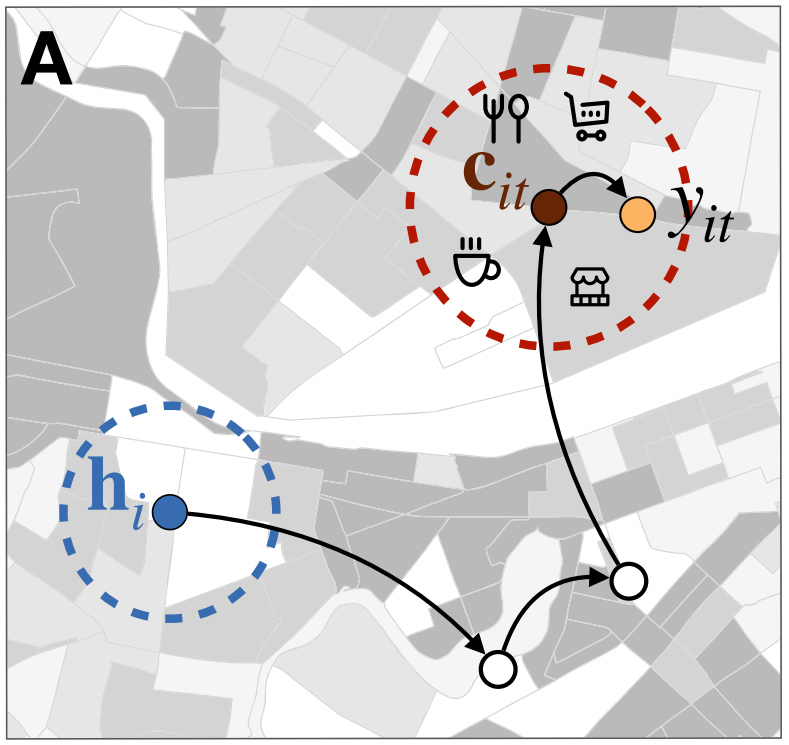
This study uses large scale human mobility data—geolocation information from our cellphones—to gain new insights about the quality of food environments people are exposed to as they move throughout the day, and test if these food environments influence our food choices. We partner with Los Angeles County government to identify strategies to use these new insights to improve healthy food access, diets, and health.
Funders: National Science Foundation (2427150, PI: A. Horn); University of Southern California, Keck School of Medicine (PIs: K. de la Haye, E. Moro, S. Pentland, A. Horn)
Who's Missing Out on CalFresh?
Hundreds of thousands of Los Angeles County residents may qualify for CalFresh, California's food assistance program (known nationally as SNAP), but aren't getting it. To help close this gap, we led survey and interview research to understand who is missing out and why. Working with our partner agencies and community organizations, we then used these insights to develop and recommend outreach strategies and messaging to reach them.
Funders: Angell Foundation (PIs: K. de la Haye, USC Public Exchange)

Photo by Sasha_Litt/iStock / Getty Images
Healthy Homes, Healthy Habits
In this study we build on the strengths of established Home Visitation Programs, which serve at-risk, low-income, diverse mothers and their infants, to test a weekly, in-home childhood obesity prevention model. We promote healthy eating and activity habits in the family, and modify the home environment and families' social networks so that they provide support for their healthy habits.
Funder: NIH/NICHD R01HD092483, 2017-2023 (PIs: K. de la Haye, S.J. Salvy)

Stay Connected Los Angeles: A Public Health & Arts Campaign to Mitigate the Impact of COVID-19
This project works with local artists and community partners to develop, implement, and test an innovative public health campaign on COVID-19 that is tailored for Hispanic/Latinx communities in Los Angeles. It addresses knowledge gaps and misinformation, encourages uptake of vaccinations and risk-reducing behaviors, and promotes social connectedness.
Funders: Keck School of Medicine of USC COVID-19 Research Fund, 2020-2022 (PIs: L. Baezconde-Garbanati, K. de la Haye)

Photo by mattjeacock/iStock / Getty Images
Network Science of Teams
This Multi-University Research Initiative (MURI) supports a multidisciplinary team with expertise in cognitive and behavioral science, sociology, computer science, network science and statistics to generate multilevel, dynamic models of teams that explain various dimensions of performance and success. The resulting conceptual and statistical models that relate group composition, interaction patterns, and network evolution to task performance, will break new ground in understanding the optimal design of teams for complex tasks.
Funder: U.S. Army Research Office, W911NF-15-1-0577, 2015-2021 (PIs: Singh, Bullo, de la Haye, Friedkin, Malone, Uzzi)